Percentages are everywhere. A 30% discount at checkout. A 7% sales tax. A 12% salary raise. A 94% test score. Monthly revenue grew 18%. Your battery is at 23%. COVID vaccination rate is 67%.
Despite how common they are, percentage calculations trip people up constantly — especially percentage change, percentage of a percentage, and working backwards from a result.
Calculate Any Percentage
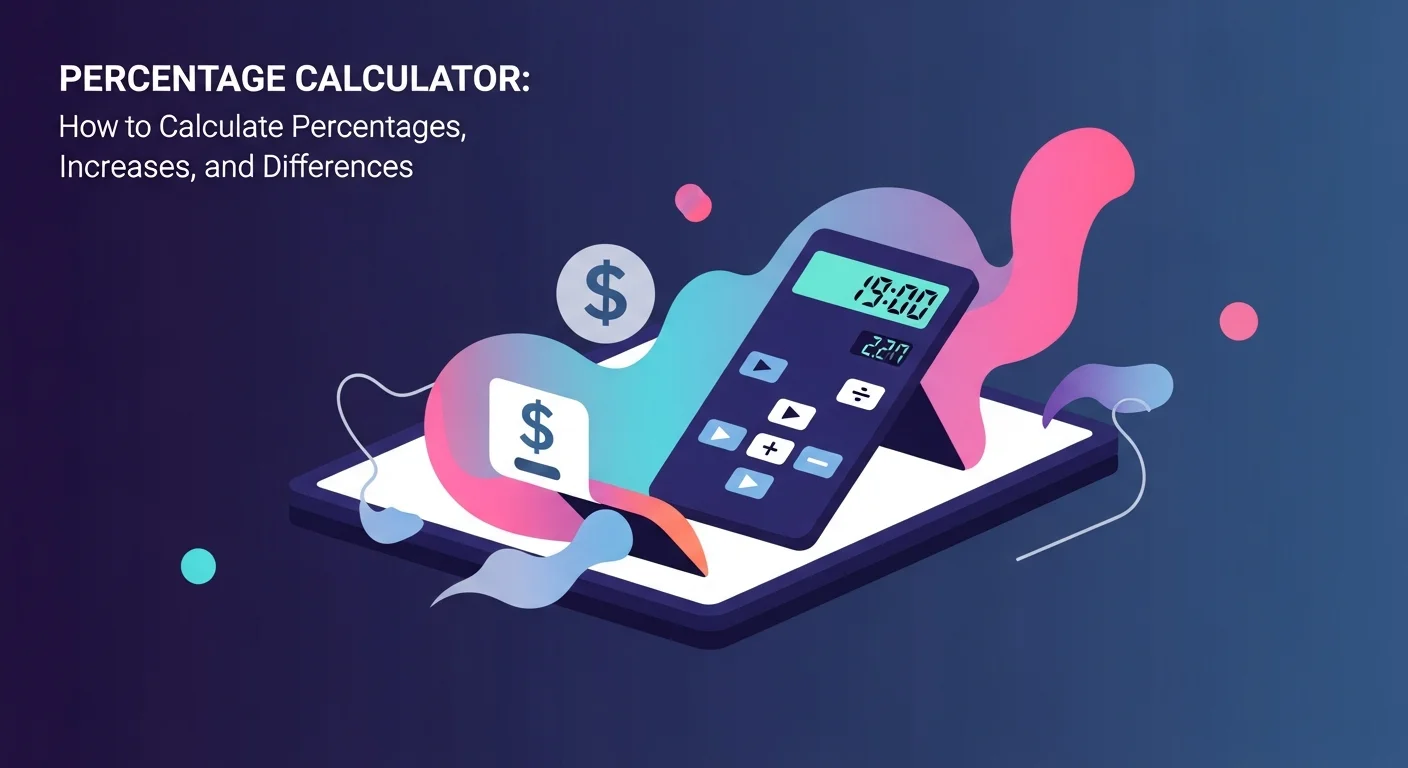
Percentage Calculator
Calculate percentage of a number, percentage change, what percent X is of Y, and work backward from a percentage — all in one tool.
The Four Core Percentage Calculations
1. What is X% of Y?
"What is 15% of $85?"
Formula: Result = (X ÷ 100) × Y
(15 ÷ 100) × 85 = $12.75
Use for: Tips, discounts, tax amounts, commission.
2. X is what percentage of Y?
"42 out of 60 — what percentage is that?"
Formula: Percentage = (X ÷ Y) × 100
(42 ÷ 60) × 100 = 70%
Use for: Test scores, completion rates, market share.
3. Percentage increase (or decrease)
"Price went from $50 to $65 — what's the percentage increase?"
Formula: Change% = ((New − Old) ÷ Old) × 100
((65 − 50) ÷ 50) × 100 = 30% increase
Use for: Price changes, salary raises, growth metrics.
4. Working backwards — what was the original value?
"After a 20% discount, the price is $80 — what was the original?"
Formula: Original = Result ÷ (1 − Discount%)
80 ÷ (1 − 0.20) = 80 ÷ 0.80 = $100
Use for: Reverse-engineering sale prices, pre-tax amounts.
Common Percentage Mistakes
Confusing percentage points with percentages.
If an interest rate rises from 4% to 6%, it rose by 2 percentage points — but by 50% (because 6 is 50% more than 4). "It went up 2%" and "it went up 2 percentage points" mean completely different things.
Adding percentages directly.
If you get a 10% raise and then another 10% raise, you don't have 20% more than your original salary. You have 21% more — because the second 10% is calculated on the already-raised amount.
The 50% up / 50% down trap.
If something increases 50% and then decreases 50%, it's not back where it started. A $100 item that goes up 50% is $150. That $150, down 50%, is $75. You've lost $25.
Real-World Percentage Quick Reference
| Scenario | Calculation Type |
|---|---|
| Restaurant tip (15–20%) | X% of total bill |
| Store discount | Percentage decrease |
| Tax calculation | X% added to price |
| Test score (42/60) | X is what % of Y |
| Salary raise | Percentage increase |
| Investment return | Percentage change |
| Sale price to original | Working backwards |
| Budget allocation | X% of total budget |
Percentage in Finance: The Numbers That Matter
Annual Percentage Rate (APR) on a credit card: This is how much you pay in interest per year. At 24% APR on a $1,000 balance, you pay roughly $240/year in interest ($20/month) — assuming you make no payments. The reality is more complex because interest compounds daily.
Inflation rate: If inflation is 5% and your salary raised by 3%, your real purchasing power decreased by approximately 2%. Your nominal salary went up; your actual purchasing power went down.
Investment returns: A 10% annual return doubles your investment in approximately 7.2 years (the Rule of 72: 72 ÷ annual return = years to double).
Privacy Note
FluxToolkit's Percentage Calculator performs all calculations in your browser using JavaScript. No data is sent to our servers. Financial figures, salary numbers, or business metrics you enter remain entirely on your device.
Frequently Asked Questions
What's the difference between "percent" and "percentage points"?
"Percent" refers to a relative change. "Percentage points" refers to an absolute arithmetic difference. If unemployment goes from 5% to 7%, it rose 2 percentage points — but increased by 40% (because 7 is 40% more than 5). The two measures tell different stories.
How do I calculate a percentage in Excel?
Format: =(A1/B1)*100 for "A1 is what % of B1". Use =(B1-A1)/A1*100 for percentage change from A1 to B1. Excel also has built-in percentage formatting that handles display automatically.
What is a "basis point"?
A basis point is 1/100th of a percentage point — 0.01%. Used primarily in finance for interest rate changes. When the Fed raises rates by 25 basis points, that's 0.25%. Financial professionals use basis points to avoid confusion with the percent/percentage point distinction.
How do I calculate compound percentage growth?
For compound growth over multiple periods: Final = Initial × (1 + rate)^periods. If something grows 10% per year for 5 years: 100 × (1.10)^5 = $161.05. This is different from simple growth of 50% (5 × 10%).
Does FluxToolkit store my calculations?
No. All calculations run in your browser. Your figures are never transmitted to our servers.