If you've worked with APIs, images in CSS, or authentication tokens, you've encountered Base64 — even if you didn't realize it. It shows up in data URLs, email attachments, HTTP headers, JWT tokens, and dozens of other places in modern web development.
Despite how common it is, Base64 trips a lot of developers up. This guide explains what it actually is, why it exists, when you should use it, and when you definitely shouldn't.
What is Base64?
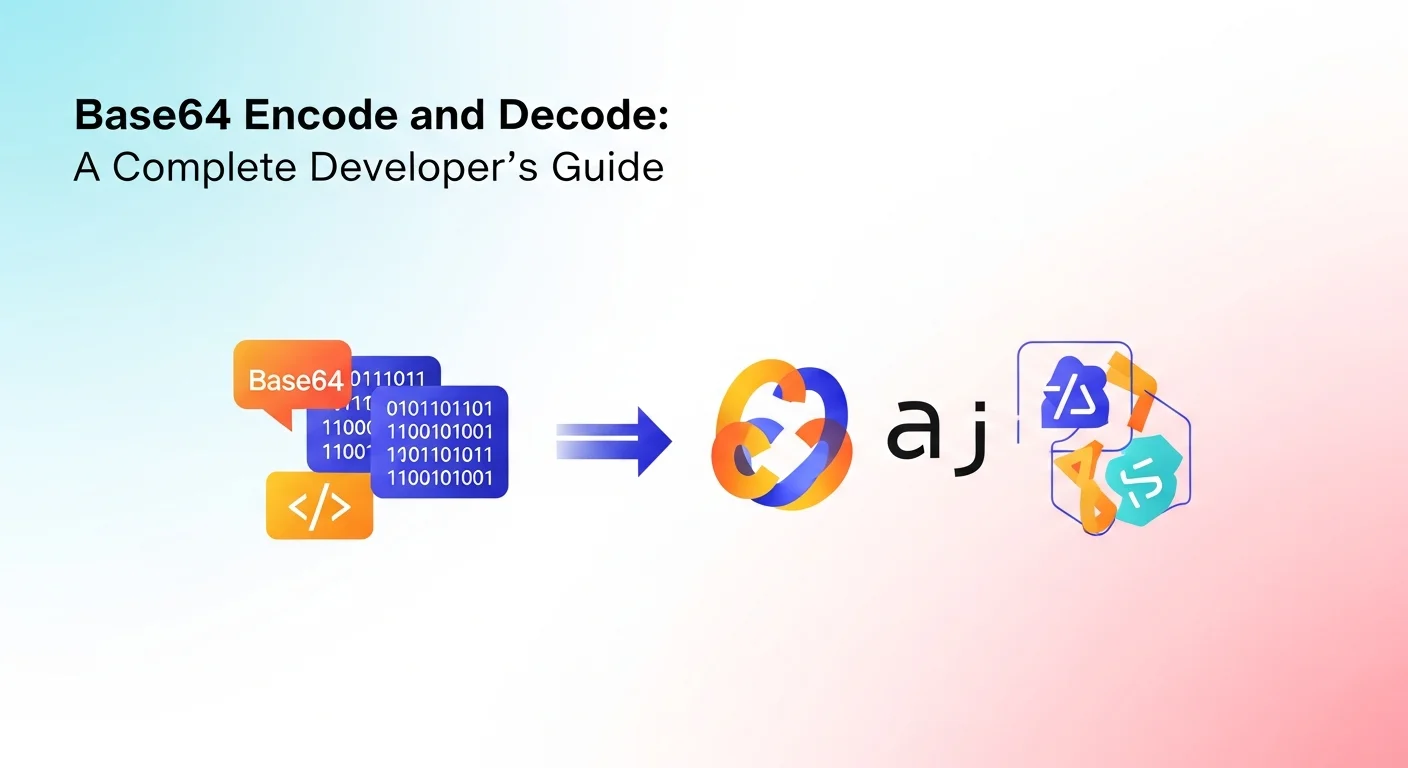
Base64 is an encoding scheme that converts binary data into a string of printable ASCII characters. The name comes from the fact that it uses 64 different characters: A–Z, a–z, 0–9, +, and / (with = used as padding).
Here's the core idea: computers store everything as binary (0s and 1s). Many systems — email protocols, HTTP headers, HTML attributes, JSON fields — were designed to handle text, not raw binary. Base64 solves this by translating binary data into a text format that can safely travel through these text-only systems.
A Quick Example
The string Hello in Base64 becomes SGVsbG8=.
Take it back through a decoder and you get Hello again. It's fully reversible — which is an important distinction from hashing or encryption (more on this below).
How the Encoding Works
Base64 works by:
- Taking the binary representation of your input data
- Grouping the bits into 6-bit chunks (instead of the usual 8-bit bytes)
- Mapping each 6-bit chunk to one of 64 printable characters
- Adding
=padding if the input length isn't a multiple of 3
The result is always about 33% larger than the original data — a predictable and unavoidable tradeoff for text compatibility.
Encode and Decode Instantly
Base64 Encoder / Decoder
Encode and decode data using Base64 encoding scheme.
Real Use Cases You'll Actually Encounter
1. Embedding Images in CSS and HTML
Instead of referencing an image file, you can embed it directly in your stylesheet or HTML as a Base64 data URL:
background-image: url('data:image/png;base64,iVBORw0KGgo...');
This eliminates an HTTP request for small icons and avoids CORS issues when loading images from another domain. It's best for small images — for large ones, the size overhead isn't worth it.
2. Decoding JWT Tokens
The payload of a JWT token is Base64Url-encoded (a URL-safe variant of Base64). When you need to inspect what's inside a token during debugging, you decode the payload:
const payload = JSON.parse(atob(token.split('.')[1]));
Remember: this only reads the payload — it doesn't verify the signature. Never trust a token just because you can decode it.
3. Handling API Responses
Some APIs return binary data (like images or files) as Base64 strings in JSON responses. You decode them client-side to render the content.
4. Basic HTTP Authentication
The HTTP Authorization: Basic header encodes username:password as a Base64 string. It's not encryption — it's just encoding. Always use HTTPS alongside it.
5. Sending Files via Email and Messaging APIs
Email protocols (SMTP) and messaging APIs often require attachments to be Base64-encoded before transmission.
Base64 vs. Encryption vs. Hashing: Important Distinctions
This is where a lot of developers go wrong:
| Feature | Base64 | Encryption | Hashing |
|---|---|---|---|
| Reversible? | ✅ Yes, easily | ✅ Yes, with key | ❌ No |
| Provides security? | ❌ No | ✅ Yes | ✅ (for integrity) |
| Purpose | Text compatibility | Confidentiality | Verification |
| Example use | Data URLs, APIs | HTTPS, AES | Password storage |
Base64 is not security. Anyone can decode it. Never use it to "hide" passwords, API keys, or sensitive data. If you need to protect information, use actual encryption.
Privacy Considerations When Encoding
If you're encoding sensitive data — API keys, authentication credentials, personal information — think carefully about where you do it:
- In the EU (GDPR): Encoding personal data through cloud-based tools means that data passes through a third party's server, which may require a data processing agreement.
- In the US: NDA agreements and security policies in most organizations prohibit sending sensitive credentials through unverified online tools.
- For developers everywhere: Encoding your real API keys or access tokens in a public online tool is a security risk — even if Base64 isn't "real" encryption, the tool still sees the plaintext value.
FluxToolkit's Base64 encoder/decoder runs entirely in your browser. Your input is processed locally using JavaScript — it's never sent to any server.
Frequently Asked Questions
Is Base64 the same as encryption?
No. Base64 is encoding — it converts data to a text-safe format. Anyone can reverse it instantly. Encryption requires a secret key to reverse. Never use Base64 to hide sensitive information.
Why is a Base64 string always longer than the original?
Because you're representing 8-bit bytes using only 6-bit groups and a 64-character alphabet. The conversion always adds about 33% overhead. It's a feature, not a bug — the tradeoff is text compatibility.
What's the difference between Base64 and Base64Url?
Base64Url replaces + with - and / with _, and omits padding =. This makes it safe for use in URLs and HTTP headers without percent-encoding. JWT tokens use Base64Url.
Can Base64-encoded data be used in a URL directly?
Standard Base64 cannot — the +, /, and = characters have special meaning in URLs. Use Base64Url encoding for URL-safe output.
Does FluxToolkit log my encoded data?
No. Everything runs in your browser. Your input — whether it's an API key, image data, or plain text — is never sent to our servers.
Related Articles

URL Encoding and Decoding Explained: A Developer's Practical Guide
A Complete Guide to Decoding JWT Tokens Locally and Safely

JSON Formatter and Validator: How to Read, Format, and Debug JSON Instantly

How to Extract Content from Image Files (Free OCR Guide)

Number Base Converter: Binary, Decimal, Hex, and Octal Explained