Here's a scary statistic: the most common password in the world is still 123456. The second most common? password.
Every day, millions of accounts are compromised in credential-stuffing attacks — where hackers take leaked password lists from one breach and automatically try them on other websites. If you reuse passwords or pick simple ones, you're one leaked database away from losing access to everything.
This guide explains what actually makes a password secure, how cryptographic hashing works, and the one mistake people make when generating passwords online that can get them hacked.
1. What Makes a Password Actually Secure?
A secure password isn't just a random word with a number tacked on the end. What matters is entropy — a measure of how unpredictable and hard to guess the password is.
Think of it like a combination lock. A 3-digit lock has 1,000 possible combinations. A 10-digit lock has 10 billion. Your password works the same way:
- Length matters most. A 16-character password using simple words is far stronger than an 8-character one packed with symbols. More characters = exponentially more combinations for an attacker to try.
- Use a mix of character types. Combining uppercase letters, lowercase letters, numbers, and symbols dramatically increases the number of possible combinations.
- Avoid predictable patterns. No dictionary words, no
qwerty, no birthdays, no pet names. Automated cracking tools know all of these.
2. Generate Strong Passwords in Your Browser — Not Someone Else's Server
Here's the mistake a lot of people make: they type "random password generator" into Google and use the first website that appears. The problem is, that website's server just saw your new password the moment it was generated.
A genuinely secure password generator should run entirely in your browser — your device generates the password locally, and it never travels across a network.
Password Generator
Create strong, random, and secure passwords instantly.
3. What Are Cryptographic Hashes? (MD5, SHA-256 Explained Simply)
A hash function takes any input — a password, a file, a document — and produces a fixed-length "fingerprint" called a hash. It has three important properties:
- Same input always produces the same output. Hash
helloand you'll always get the exact same result. - One-way only. You can hash something, but you can't "un-hash" it back to the original.
- Tiny changes cause huge differences. Change one letter in your input and the hash completely changes.
MD5 vs SHA-256: What's the Difference?
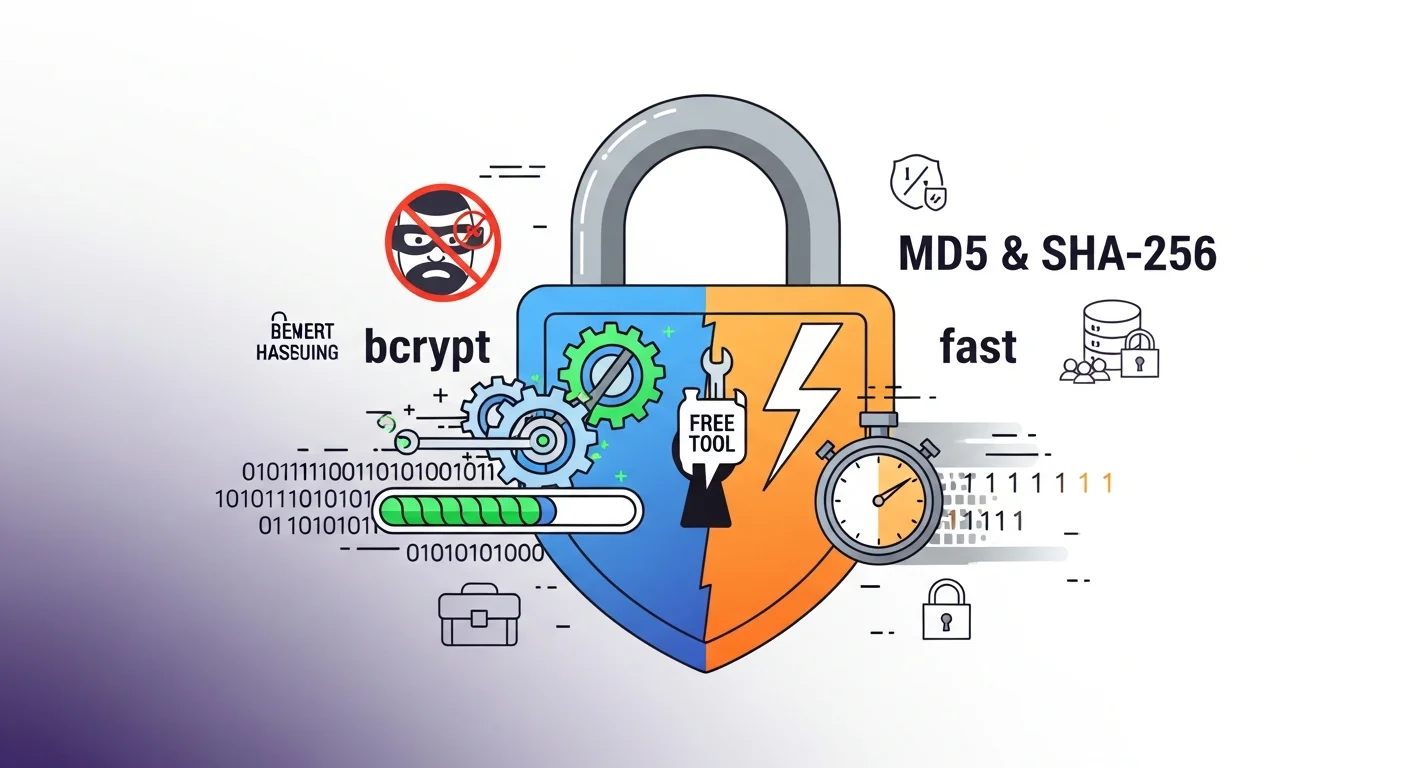
- MD5 produces a 128-bit hash. It's fast and still widely used for verifying file downloads. However, it's considered too weak for storing passwords, since its speed makes it easier to brute-force.
- SHA-256 produces a 256-bit hash. It's the modern standard used in SSL certificates, Bitcoin, code signing, and most security-critical applications.
MD5 Hash Generator
Generate secure MD5 cryptographic hashes for any text.
Why This Matters Depending on Where You Are (GDPR, CCPA, HIPAA)
Password generation and data hashing aren't just technical concerns — they're legal ones too.
- In Europe (GDPR, Article 32): Organizations are required to implement appropriate technical measures to protect personal data. Using a cloud-based tool to generate passwords or hash sensitive identifiers means that data is being processed by a third party — often without a proper data processing agreement.
- In the US (CCPA & HIPAA): Healthcare providers and businesses handling personal data must prevent unauthorized access. Sending raw credentials or patient identifiers to external web services creates unnecessary exposure.
- In India (DPDP Act): Companies must protect personal data and prevent unauthorized processing or leaks.
When you use a browser-based tool, everything stays on your device. No server logs, no third-party exposure, no compliance headaches.
Frequently Asked Questions
What is password entropy?
Entropy is a measure of how unpredictable a password is. The higher the entropy, the longer it would take an automated attack to guess the correct password by trying every possibility.
Can MD5 hashes be reversed?
Not mathematically — but in practice, weak or common inputs can be cracked using "rainbow tables," which are pre-computed databases of known hash values. This is why SHA-256 is preferred for anything security-critical.
How do developers use hashes to verify downloads?
When software is published, the developer also publishes a checksum (hash). After downloading, you can run the same hash on your local copy. If the values match, the file wasn't modified in transit.
Does FluxToolkit log my passwords or hashed inputs?
No. Both the Password Generator and MD5 tool run entirely in your browser. Nothing you type or generate is ever sent to our servers.