Your headline is the single most important line of copy in your content. Even if your article is extremely thorough, it will go unread if the title fails to capture the reader's attention.
Research shows that while 8 out of 10 users read a headline, only 2 out of 10 click through to read the article body. A headline must perform a double duty: it has to be engaging enough to win user clicks (CTR) and structured correctly to rank in search engines (SEO).
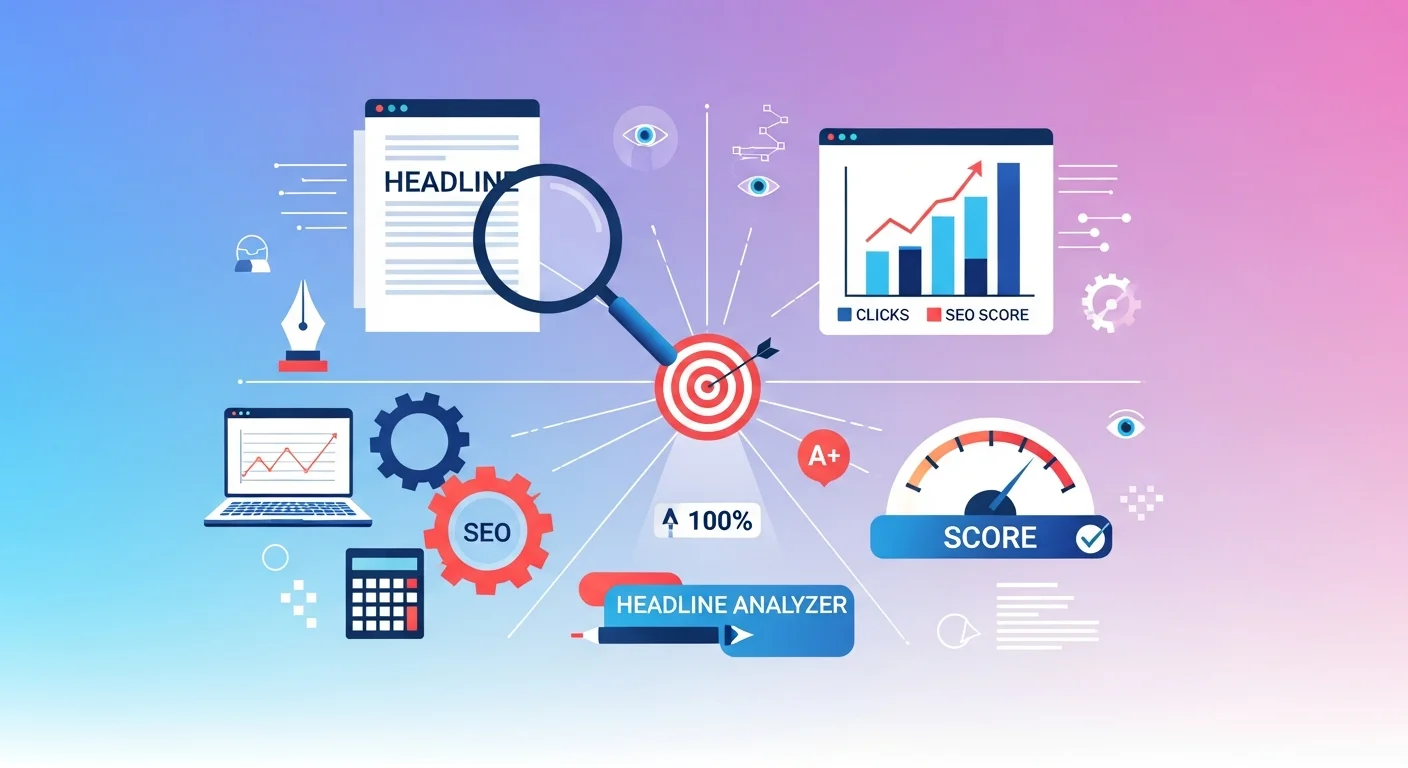
To help you audit your titles before publishing, FluxToolkit provides a free, client-side Headline Analyzer.
Headline Analyzer
Score your headlines 0–100 for SEO and click potential. Analyzes power words, emotional words, character length, and word balance — instantly in your browser.
The Anatomy of a High-Scoring Headline
Our headline analyzer evaluates titles across five key metrics to generate a score from 0 to 100:
1. Character Length (Optimal: 50–65 characters)
Google truncates titles at approximately 600 pixels in search results. Keeping your headline within 50 to 65 characters ensures it displays fully across both desktop and mobile layouts without cutoffs.
2. Word Count (Optimal: 6–10 words)
Studies show that headlines consisting of 6 to 10 words receive the highest click-through rates. Titles that are too short fail to establish context, while titles that are too long lose punchiness.
3. Word Balance (Power, Emotional, Common, Uncommon)
The analyzer splits your headline into four categories of words:
- Common Words: Core structural words (e.g., how, to, your, standard). They should make up 20-30% of your headline.
- Uncommon Words: More specific, descriptive words (e.g., secrets, methods, blueprint). Aim for 10-20%.
- Power Words: High-impact words that create urgency, exclusivity, or authority (e.g., proven, ultimate, guaranteed, essential). Aim for 5-20%.
- Emotional Words: Words that evoke psychological responses (e.g., shocking, brilliant, fearless, risk-free). Aim for 10-20%.
Finding the perfect equilibrium between these four semantic categories is the true hallmark of professional copywriting. Striking this exact mathematical balance guarantees maximum reader engagement and effectively prevents your content from sounding like automated spam.
4. Inclusion of Numbers
Numbered headlines (especially odd numbers) receive significantly more clicks (e.g., "7 Ways to..." vs. "How to..."). Numbers set clear expectations of read time and structure.
5. Question Format
Questions engage the reader's natural curiosity gap (e.g., "Are You Making These Coding Mistakes?").
50 Emotional Power Words for Better CTR
If your headlines are falling flat, the easiest fix is to inject an emotional trigger. These words bypass logical filtering and tap directly into a reader's curiosity, fear of missing out (FOMO), or desire for simplicity. Here are some of the highest-converting power words organized by emotion:
- Curiosity: Secret, Bizarre, Shocking, Sneak Peek, Hidden, Underground, Unbelievable, Myth, Confession.
- Urgency / FOMO: Limited, Fast, Deadline, Expiring, Final, Now, Today, Urgent, Critical.
- Trust / Authority: Proven, Guaranteed, Official, Authentic, Certified, Expert, Research-Backed, Tested, Reliable.
- Simplicity: Easy, Effortless, Painless, Quick, Simple, Step-by-Step, Blueprint, Cheat Sheet, Hack.
- Exclusivity: Insider, Member-Only, Premium, Elite, Restricted, Private, VIP, First-Access.
Pro-Tip: Do not stuff your headline with too many power words. Using one or two carefully placed emotional triggers is incredibly effective; using five makes your title look like spam.
Categorizing Word Types (JavaScript Parser Logic)
Our client-side analyzer checks every word in your input against categorized word libraries. Here is a look at the JavaScript categorization logic:
const powerWords = new Set(['ultimate', 'proven', 'guaranteed', 'essential', 'free', 'insider', 'easy', 'secret']);
const emotionalWords = new Set(['shocking', 'amazing', 'fearless', 'brilliant', 'painful', 'scary', 'worry-free']);

function analyzeWordBalance(wordsList) {
  let powerCount = 0;
  let emotionalCount = 0;

  wordsList.forEach(word => {
    const cleanWord = word.toLowerCase().replace(/[^\w]/g, '');
    if (powerWords.has(cleanWord)) powerCount++;
    if (emotionalWords.has(cleanWord)) emotionalCount++;
  });

  return {
    powerPercentage: (powerCount / wordsList.length) * 100,
    emotionalPercentage: (emotionalCount / wordsList.length) * 100
  };
}
Step-by-Step: How to Test and Improve Headlines
Follow these steps to optimize your article titles:
Step 1: Input Your Headline Draft
Type your candidate title into the input box.
Step 2: Read Your Score
Review your score card (0-100). Aim for a score of 70 or above for commercial and editorial content.
Step 3: Analyze the Word Balance
Look at the gauge meters. If your headline is 100% common words, it will read flat. Add an emotional word or a power adjective to make it more compelling.
Step 4: Check Length Indicators
Look at the length bar. If your title is highlighted in red, it is too long (and will get truncated in Google) or too short (lacking keyword context).
Step 5: Implement Recommendations
Read the improvement tips generated at the bottom of the analyzer. These tips will suggest actions such as adding a number, asking a question, or replacing weak verbs.
Frequently Asked Questions
Why do numbered headlines perform better?
Numbered headlines (known as listicles) perform better because they set clear expectations of the article's structure and readability. The reader knows exactly what they are getting and can scan the list quickly, which reduces the perceived effort to read.
Does a high score guarantee my post will rank #1?
No. The Headline Analyzer evaluates the click potential and formatting of your title. Ranking #1 on search engines depends on page authority, backlinks, page load speeds, and content quality. However, a high-scoring headline will maximize the CTR of the impressions you do get.
Should I prioritize SEO keywords or clickability?
You should balance both. A great headline includes your primary keyword near the beginning of the title for search engines, while using emotional and power words toward the middle or end to attract user clicks.
Does Google rewrite search titles even if they are under 60 characters?
Yes. If Google's algorithm determines that your headline does not accurately reflect the content of your page or match the user's specific search query, it will automatically rewrite the title link in search results.
Are my headlines stored on your servers?
No. The Headline Analyzer runs entirely within your browser using client-side JavaScript. Your draft headlines are processed locally and are never stored or transmitted to external servers.