A few quarters ago, our operations team was handling a major compliance audit. We received a batch of eighty contract agreements, all locked as PDF files, containing minor typos in the vendor clause. Eager to fix them quickly, a junior paralegal uploaded the entire folder to a free online PDF-to-Word converter.
When they got the DOCX files back, they were a complete mess. Every single line of text had been converted into an independent floating text frame, column formatting was broken, and half of the tables had their grid borders stripped. Worse, after an audit, we realized that these files—which contained sensitive financial disclosures and corporate signatures—had just been uploaded to an unverified third-party cloud server, violating our GDPR data handling policy.
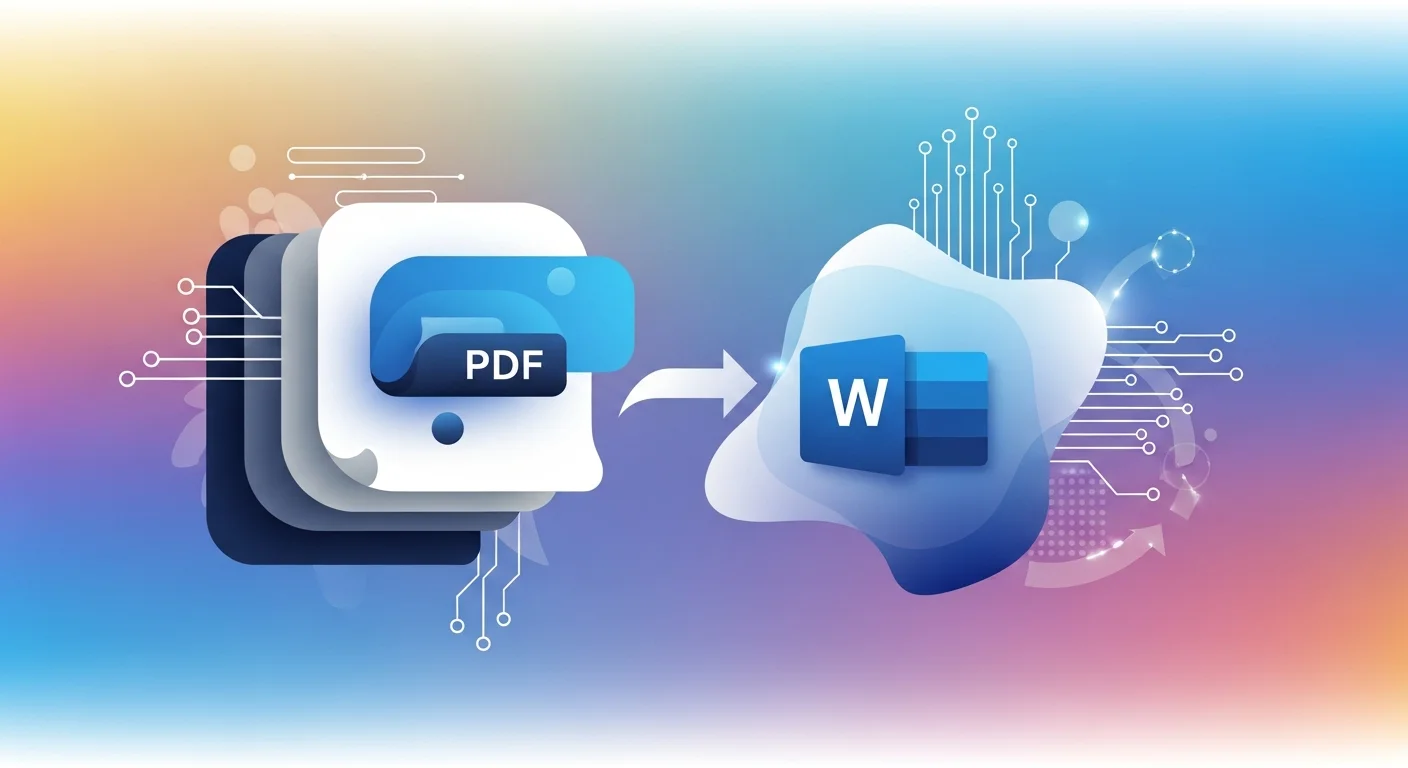
This experience highlights a common headache in offices worldwide: Why is converting a PDF to a Word document so difficult, why does it often break your formatting, and how do you do it securely?
1. Why PDF and Word Files Are Built Differently Under the Hood
To understand why document conversion frequently fails, you must understand that PDF (Portable Document Format) and DOCX (Word Open XML) were built for entirely opposite purposes.
graph TD
    A["Document Format Architectures"] --> B["PDF (Fixed-Position Layout)"]
    A --> C["DOCX (Reflowable Flow Layout)"]

    B --> B1["Purpose: Standardized print/display fidelity"]
    B --> B2["Structure: Coordinates on canvas X, Y"]
    B --> B3["Behavior: Text does not wrap, fonts embedded"]

    C --> C1["Purpose: Dynamic content creation & editing"]
    C --> C2["Structure: Paragraphs, sections, lists"]
    C --> C3["Behavior: Text wraps dynamically to fit screen"]
PDF: The Digital Paper
PDF was invented by Adobe in the 1990s as a digital equivalent of physical paper. Its main objective is visual fidelity. When you open a PDF on an iPhone, a Windows server, or print it out, it must look exactly the same.
To achieve this, a PDF file does not store text as a sequence of paragraphs. Instead, it stores characters as individual vector canvas coordinates (e.g., Draw letter 'H' at coordinate X:50, Y:120). It has no natural concept of a "sentence", a "heading", or a "table column"—only coordinates.
Word (DOCX): The Flowing Document
Word files are built as a flow-based document. A DOCX file stores document elements hierarchically: a document contains sections, which contain paragraphs, which contain runs of text with formatting styles. When you change your margins or resize your window, the text wraps dynamically.
When a PDF-to-Word converter processes your file, it must reverse-engineer this fixed coordinate system into a logical flow system. It has to look at groups of characters, guess if they form a word, check the horizontal spacing to guess if they form a paragraph, and analyze lines to guess if they represent a table grid.
2. Text-Based vs. Image-Based (OCR) PDF Parsing
Not all PDFs are created equal. When selecting a converter, the type of PDF you have dictates the matching strategy:
Text-Based PDFs (Native)
A native PDF is generated directly from an application (like Microsoft Word, Google Docs, or a code editor). It contains a distinct digital text layer. When you open a native PDF, you can highlight, copy, and search for words.
- Conversion Success: Excellent. The converter can read the character tags directly, yielding highly accurate spelling and layout reconstructions.
Image-Based PDFs (Scanned Documents)
An image-based PDF is created when you scan a physical paper document or save a screenshot as a PDF. It does not contain any digital text layer—it is simply a collection of pixels in a wrapper.
- Conversion Success: Challenging. The converter must run OCR (Optical Character Recognition) software, using machine learning to read the image pixels, recognize shapes as letters, and transcribe them into text.
- If the scan is slightly rotated, contains handwriting, or has low resolution, OCR will introduce spelling mistakes.
3. Comparison of Document Conversion Methods
The table below outlines the pros, cons, and privacy implications of the different ways to convert PDFs to editable Word documents:
| Conversion Method | Processing Model | Formatting Quality | Privacy & Safety | Cost |
|---|---|---|---|---|
| FluxToolkit PDF Tools | Local In-Browser | High (Converts to clean HTML/DOCX) | Excellent (No upload, client-side only) | 100% Free |
| Cloud-based Converters | Remote Server | Very High (Proprietary parsers) | ❌ Poor (Files sent to external servers) | Free / Pay-per-file |
| Microsoft Word (Open PDF) | Local Desktop | Moderate | Excellent | Paid subscription |
| Adobe Acrobat Pro | Local Desktop | High | Excellent | Paid subscription |
4. The Security Risk of Free Online Converters
Most free PDF-to-Word tools found via search engines operate on a client-server model. When you click "Convert", your document is uploaded to their remote server, processed, and then sent back as a download link.
For personal, non-sensitive documents, this model is fine. But for professionals, businesses, and public agencies, uploading documents to unknown servers is a major security risk and a violation of compliance laws:
GDPR (General Data Protection Regulation - Europe)
If your PDF contains personal identifier data (names, addresses, tax codes) of European citizens, uploading it to a cloud server without a structured Data Processing Agreement (DPA) is a direct compliance breach, exposing your company to massive regulatory fines.
HIPAA (Health Insurance Portability and Accountability Act - United States)
Healthcare organizations cannot transmit Protected Health Information (PHI) via tools that are not secured and covered by a Business Associate Agreement (BAA). Using standard cloud converters violates patient privacy.
DPDP Act (Digital Personal Data Protection - India)
Organizations operating in India must ensure that personal data is processed with consent and stored securely, making unverified external cloud processing an unacceptable risk.
The Solution: Local Browser Execution
This compliance liability is why we engineered FluxToolkit's PDF to Word Converter with a serverless architecture. By leveraging the modern HTML5 File Reader API and local WebAssembly compilation, your document is processed entirely inside your browser sandbox. The file never leaves your device, keeping your data confidential and fully compliant with privacy laws.
PDF to Word
Convert PDF documents to editable .docx format instantly and privately.
5. Tips for Clean Layout Output
To get the cleanest possible DOCX file with minimal formatting bugs, apply these preparation steps:
- Flatten Form Fields: If your PDF contains interactive form inputs, export it as a flattened PDF before converting. This prevents form tags from translating into floating text blocks in Word.
- Avoid Scanned Column Layouts: OCR has a difficult time distinguishing columns in scanned documents, often reading straight across columns. If you only need the text, use a text extractor instead of a full visual layout parser.
- Ensure Fonts Are Common: If your PDF uses obscure, custom vector fonts that are not installed on your system, Word will substitute them with default fonts (like Calibri or Arial), shifting character wrapping and alignment.
If your layout is too complex and you only need to copy the content into a report or draft, use a text extractor to pull clean text without formatting constraints.
PDF Text Extractor
Extract all readable text from any PDF file instantly and privately.
Frequently Asked Questions (FAQ)
What is a PDF to Word converter?
It is a document processing utility that parses the vector coordinates and layout blocks of a PDF file and reconstructs them as flowing paragraphs, tables, and sections in Microsoft Word (.docx) format.
Why does text in my converted Word file appear in separate boxes?
This occurs when a converter cannot determine if consecutive lines of text belong to the same paragraph. To maintain visual placement, it places each line into an independent, absolutely-positioned textbox. While this looks correct, it makes editing the document extremely difficult.
Is my personal data safe when using FluxToolkit?
Yes. FluxToolkit processes files using local Javascript and browser APIs. Your files are never uploaded to our servers, meaning we have no access to your documents, ensuring privacy.
How do I convert a scanned PDF that doesn't let me select text?
To convert a scanned PDF, you must use a converter that supports OCR (Optical Character Recognition). The OCR software reads the document image and converts the pixel characters into editable text.
Can I convert a password-protected PDF?
Yes, but you must enter the password to unlock the document first. PDF converters respect file encryption and cannot process locked files unless they are decrypted with the correct user password.
Take Control of Your Document Workflows
Converting documents between fixed and reflowable formats requires advanced parsing logic. By choosing a converter that executes locally, you can protect your confidential company files and meet strict regulatory standards while still getting clean, editable files.
Ready to convert your contract or report? Head over to our Secure PDF to Word Converter and process your files locally today.