Both SHA-256 and SHA-512 are members of the SHA-2 (Secure Hash Algorithm 2) family, standardised by NIST. They're both cryptographically secure, collision-resistant, and suitable for data integrity use cases. The choice between them depends on your hardware, your security requirements, and what you're hashing.
Generate a SHA-512 Hash
SHA-512 Generator
Generate SHA-512 hashes from text.
SHA-2 Family Overview
| Algorithm | Output Size | Internal Block Size | Security Level |
|---|---|---|---|
| SHA-224 | 224 bits (28 bytes) | 512-bit blocks | 112-bit security |
| SHA-256 | 256 bits (32 bytes) | 512-bit blocks | 128-bit security |
| SHA-384 | 384 bits (48 bytes) | 1024-bit blocks | 192-bit security |
| SHA-512 | 512 bits (64 bytes) | 1024-bit blocks | 256-bit security |
| SHA-512/256 | 256 bits (32 bytes) | 1024-bit blocks | 128-bit security |
SHA-224, SHA-384, and SHA-512/256 are truncated variants used in specific protocol contexts. For general use, SHA-256 and SHA-512 are the primary choices.
How They Differ Technically
SHA-256 and SHA-512 are structurally similar — both use the Merkle-Damgård construction with Davies-Meyer compression — but with key differences:
Word size: SHA-256 operates on 32-bit words; SHA-512 operates on 64-bit words. This is the fundamental reason SHA-512 is faster on 64-bit architectures.
Rounds: SHA-256 performs 64 rounds of compression; SHA-512 performs 80 rounds.
Block size: SHA-256 processes 512-bit (64-byte) blocks; SHA-512 processes 1024-bit (128-byte) blocks, making it more efficient for large inputs.
Performance: Which is Faster?
Counterintuitively, SHA-512 is often faster than SHA-256 on modern 64-bit systems for large inputs — even though it produces more output.
| Platform | SHA-256 vs SHA-512 |
|---|---|
| 64-bit CPU (modern server/desktop) | SHA-512 is ~30–50% faster |
| 32-bit CPU or ARM without 64-bit ops | SHA-256 is faster |
| GPU computation | SHA-256 is faster (optimised for 32-bit parallelism) |
| Hardware acceleration (AES-NI, SHA-NI) | SHA-256 wins (hardware SHA extension focuses on 256) |
On a typical modern server CPU, SHA-512 processes about 1.6 GB/s compared to SHA-256's ~1.1 GB/s for large data, because the 64-bit architecture executes 64-bit operations natively.
SHA-256 vs SHA-512: When to Use Each
Use SHA-256 When:
- Industry compatibility matters: SHA-256 is the standard in Bitcoin, TLS 1.3 certificate signatures, JWT (HS256/RS256/ES256), HMAC-SHA-256, and most modern protocols
- Hardware acceleration is available: SHA-NI extensions (Intel/AMD) accelerate SHA-256 specifically
- You need the widest toolchain support: Every crypto library, security tool, and platform supports SHA-256
- Output size matters: 32-byte hashes are smaller in storage and transmission
- Mobile/embedded targets: 32-bit ARM processors are still common in embedded systems
Use SHA-512 When:
- Maximum security margin is required: 256-bit security (SHA-512) vs 128-bit (SHA-256) — overkill for most, but relevant for very long-term archival integrity
- Large file hashing on 64-bit servers: SHA-512 is noticeably faster for hashing large files server-side
- Password hashing (intermediate pre-hash): Some PBKDF2 implementations use SHA-512 as the underlying PRF — PBKDF2-SHA-512 is commonly used
- Avoiding GPU crack concerns: SHA-512 is computationally harder on GPU rigs than SHA-256, which matters slightly if using a hash in contexts where brute-force resistance matters (though you should use bcrypt/Argon2 for passwords)
What SHA-512 Is NOT For
SHA-512 shares the same limitations as SHA-256 when misapplied:
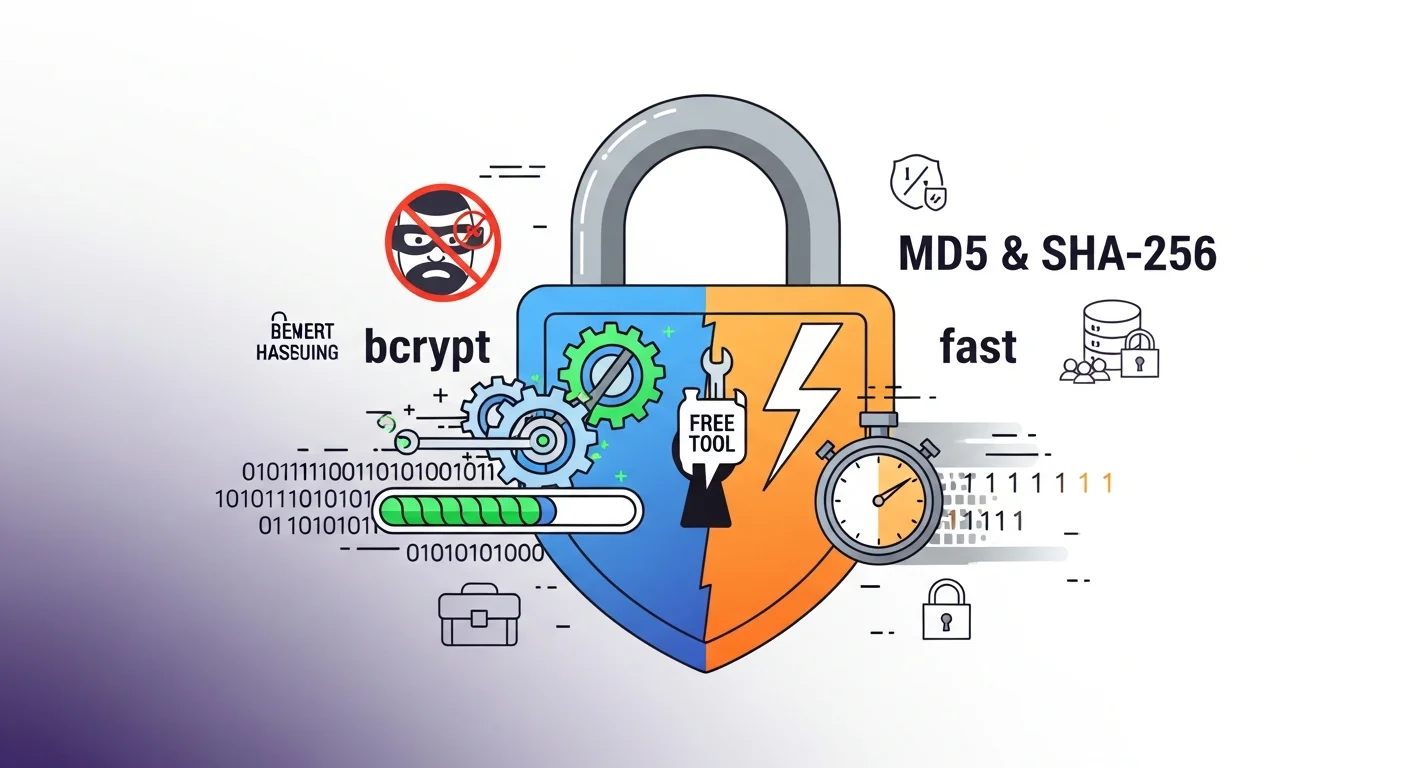
Not for password storage: SHA-512 alone (even salted) is not appropriate for password hashing. GPUs can still compute billions of SHA-512 hashes per second. Use bcrypt, scrypt, or Argon2id — all of which are intentionally slow.
Not inherently more "secure" for typical uses: For a 1MB file checksum, SHA-256 and SHA-512 provide equivalent practical security. The extra bits provide theoretical resistance to attacks that aren't feasible against either algorithm with current technology.
A SHA-512 Hash Example
Input: "Hello, World!"

SHA-256: dffd6021bb2bd5b0af676290809ec3a53191dd81c7f70a4b28688a362182986d
SHA-512: 374d794a95cdcfd8b35993185fef9ba368f160d8daf432d08ba9f1ed1e5abe6cc69291e0fa2fe0006a52570ef18c19def4e617c33ce52ef0a6e5fbe318cb0387
SHA-512 output is 128 hex characters; SHA-256 is 64. In binary, 64 bytes vs 32 bytes.
Practical Encoding Formats
SHA-512 hashes are commonly represented as:
- Hex (hexadecimal): 128-character string — most common in developer tools
- Base64: 88-character string — more compact; common in HTTP headers and JWTs
- Binary: 64 raw bytes — used in low-level crypto operations
Privacy Note
FluxToolkit's SHA-512 generator hashes your input entirely in your browser using the Web Crypto API. Your data is never transmitted to our servers. The hash is computed locally on your device.
Frequently Asked Questions
Is SHA-512 more secure than SHA-256?
In terms of theoretical security margin, yes — 256-bit vs 128-bit security. In practice, both are secure against all known attacks, and 128-bit security (SHA-256) is considered sufficient for everything short of quantum computing threats. SHA-512's larger margin is rarely the deciding factor in algorithm selection.
Which should I use for file checksums?
SHA-256 is the standard for file integrity verification (software downloads, container images, code signing). SHA-512 is equally valid but SHA-256 is more universally expected and toolchain-compatible.
Can SHA-512 be cracked?
SHA-512 is not "crackable" in the sense of reversing the hash to find the original input. Like all SHA-2 variants, it's a one-way function. Attackers can only brute-force known inputs — which is why SHA-512 (like SHA-256) is inadequate for password hashing without a proper KDF.
Is SHA-3 better than SHA-512?
SHA-3 uses a completely different construction (Keccak sponge) and provides comparable security. Neither is definitively "better" — they're alternative designs providing similar security levels. SHA-2 (including SHA-512) remains the dominant standard due to its decade-long deployment record.
Does FluxToolkit store the data I hash?
No. Hashing is performed client-side using the browser's built-in Web Crypto API. Your input never reaches our servers.